A quiet but rapidly expanding corner of the U.S. healthcare industry is turning high-tech medical imaging into a consumer product for health-conscious patients sometimes dubbed, “the worried-well.” Companies such as Prenuvo, Ezra (now integrated with Function Health), and SimonMed are marketing whole-body MRI scans directly to Americans who want a proactive, inside look at their health. Prices range from about $999 for targeted torso scans to $2,499–$3,999 (or more with add-ons and memberships) for comprehensive whole-body evaluations. None are covered by traditional insurance.
Demand is growing among consumers who have an eye on longevity and maximizing their “healthspan” – the amount of years in a person’s life that is active and disease-free. Proponents point to a broad consensus by medical professionals that early detection of solid tumors, aneurysms, and other issues before symptoms appear give patients their best chance for a cure.
“The overwhelming emotion that I observed was just gratitude to have insight into their health,” said Andrew Lacy, the founder and CEO of the full-body scan company Prenuvo – a sentiment he echoed following his own full body scan.
“I got on a plane back to Silicon Valley and I just couldn’t shake this peace of mind,” he said.
The high tech entrepreneur was so moved by the sense of empowerment that he stopped the development of his then-current venture to focus instead on bringing the medical equipment once reserved for top-tier hospitals to everyday consumers who wanted to know more about their health.
But critics, including experts writing in JAMA, warn the scans could spark an “epidemic of incidentalomas” — harmless findings that can trigger expensive, invasive, and sometimes unnecessary follow-up tests — and highlight the lack of robust evidence that these scans save lives or reduce overall costs in low-risk populations.
Despite the word of caution, however, the market is expanding, part of a broader shift toward direct-pay and concierge medicine where patients pay out-of-pocket for speed, personalization, and control.
Medical imaging emerged as a distinct field of practice through one of the most consequential accidental discoveries in modern medicine. Along with vaccines, handwashing for sanitation, clean water (germ theory), and antibiotics, it ranks among the handful of breakthroughs widely credited with doubling average human lifespan in roughly a century.
In November 1895, German physicist Wilhelm Röntgen was experimenting with electrical current in a darkened lab when a fluorescent screen across the room began to glow from an unknown source. The phenomenon proved to be a previously unidentified form of electromagnetic radiation. Within weeks, Röntgen produced an image of the bones inside his wife’s hand — an X-ray photograph. For the first time, medicine had a view inside of a living body without the use of a scalpel. Six years later, Röntgen’s discovery earned him the first-of-its-kind Nobel Prize for Physics.
Early clinical use spread quickly. One of the first documented North American application came a few months later in Montreal in February 1896, when a physicist used the technology to locate a bullet in a patient’s leg. Military surgeons deployed X-ray equipment in the field during the Greco-Turkish War of 1897 and the Spanish-American War of 1898.
Routine hospital adoption, however, took considerably longer. At Pennsylvania Hospital for example, fewer than 10 percent of patients received X-rays as late as 1909, and only about a quarter by 1925.
As the technology was refined and machines were tuned with better precision, the amount of radiation needed to produce an image dropped dramatically, along with the cost of the devices. The growing ubiquity of the ‘X-ray machines’ also spurred the rapid demand and development of a new kind of medical professional: the radiologist.
Today, a standard chest X-ray delivers approximately the same dose as 10 days of ordinary environmental background radiation.
Subsequent decades brought more advances in medical imaging. Ultrasound technology, developed using the principles of sonar, reached clinical use in the late 1950s and gained wide adoption through the 1960s and 1970s. Operating without ionizing radiation, it generates real-time imagery of soft tissue that became the standard tool for fetal monitoring.
Computed tomography (CT), introduced in the 1970s, applies X-ray data across multiple cross-sectional planes, which computers then reconstruct into detailed volumetric images. The technique uses significantly more radiation than conventional X-ray that varies depending on the area of the body under examination. A typical chest or abdominal CT uses between 70 to 100 times the dose of a standard chest X-ray.
The development of magnetic resonance imaging (MRI) was happening at the same time in upstate New York and then Nottingham, England.
In 1971, Raymond Damadian — then a SUNY Downstate Medical Center professor — published a paper reporting that cancerous tissues produced different magnetic resonance signals than healthy ones, suggesting that the physics of atomic behavior might be turned into a cancer-detection tool. He filed for a U.S. patent in 1972 and received it in 1974. It was the world’s first patent in the field.
MRI works by taking advantage of the behavior of hydrogen atoms in body tissues under strong magnetic fields. When a radiofrequency pulse disrupts their alignment – like tapping a tuning fork – the atoms emit signals as they return to equilibrium. Computers translate those signals — the frequency of which differ between various tissues — into detailed images of organs, blood vessels, muscles, cartilage, and et cetera. The process involves no radiation and often, no need for the patient to drink or inject a contrast agent.
Building on Damadian’s discovery, Stony Brook University chemist Paul Lauterbur conceived a way to use gradient magnetic fields to actually produce an image from those signals. British physicist Peter Mansfield further refined the process to produce sharper imaging much faster, along with creating ability for “slice selection.”
The first scan of a living human using magnetic resonance was conducted in 1977; the FDA granted approval seven years later in 1984.
In 2003, only Lauterbur and Mansfield were awarded the Nobel Prize for Physiology or Medicine.
The following year in 2004, Damadian received the Bower Award for Business Leadership from The Franklin Institute for his efforts to bring MRI machines to the marketplace.
The Wellness Economy
For most of its history, medical imaging was ordered by a physician in response to a specific clinical question. But that model is shifting. Boutique medical offices offering “4-D” fetal imaging services using ultrasound was the first to enter the consumer market directly, and MRI services are now following as freestanding outpatient clinics offer whole-body scans marketed as a comprehensive, proactive health screening aimed at catching disease in its earliest stages.
The move to consumer-directed preventive scans comes as the message about early detection hits home at the same time as the cost of healthcare continues to climb.
Since 1999, the average total family health insurance premium increased by about 342 percent, while worker contributions toward those premiums have risen by 308 percent. Overall, healthcare prices have outpaced inflation by 1.4 times.
For example, in the early 1960s, a routine hospital delivery often cost around $400 (roughly $4,000 in today’s dollars). By around 1990, average charges for a delivery were in the $4,000 range (about $10,000 in today’s dollars). The most recent records from 2023 show that the average total cost for a hospital birth averages about $15,700.
Today, the United States spends roughly $5.3 trillion annually on healthcare across the boards, which represents about 18 percent of GDP.
Yet less than 4 percent of that spending goes toward prevention.
“We are conditioned by this healthcare system that we have today to not want to look into our health,” Lacy said. “Almost every story we hear about a diagnosis is a bad story.”
He added, “I tell my team all the time, our mission really is to create positive stories with great health outcomes, because that’s going to lead people to want to actually, you know, look into their health and react in a less anxious way when they learn things about their health.”
Enter, concierge medicine and the broader direct-pay movement. Patients pay annual fees or per-service costs to bypass insurance bureaucracy for longer appointments, same-day access, and personalized care. From 2018 to 2023, the number of concierge and direct primary care practices grew 83 percent, with clinicians in these models increasing 78 percent.
This fits neatly into the booming wellness economy. Americans already spend billions on supplements, wearables like Oura rings and Whoop bands, fitness trackers, and high-end gym memberships. On-demand full-body scans are one of the newest, perhaps most comprehensive, ways for people to “own their health.”
Full-Body Scan Companies and What They Offer
The competitive landscape includes several players, all operating on a direct-pay model. Specific services and availability varies depending on location.
As of press time, Prenuvo leads the way with premium, research-grade 1.5T MRI machines optimized for whole-body imaging. Its most popular Comprehensive Whole Body Scan costs $2,499 (about 60 minutes) and evaluates major organs, brain, and spine for solid tumors (stage 1 and above), aneurysms, cysts, inflammation, and more than 500 conditions. Membership tiers add lab panels and follow-ups: Core ($1,199), Comprehensive ($2,499), and Executive ($3,999–$4,499 in New York City). Results include AI-enhanced reports and provider reviews.
Ezra (now integrated with Function Health) offers faster, AI-powered options starting at $999 for a 22-minute scan of head, neck, abdomen, and pelvis (detecting potential cancers and abnormalities in 13+ organs). Adding a spine scan brings it to $1,699 (47 minutes); the top tier with skeletal/neurological assessment is $3,999. FDA-cleared AI enhances images and reports, with results in 7–10 days and optional provider consults. Function Health membership ($365/year) unlocks discounts and lab integration.
SimonMed, a large established radiology network, entered with more affordable 3T MRI options. Core MRI starts at $999 (intro $899, ~30 minutes) covering chest, abdomen, pelvis, and key organs for early-stage cancers. Add-ons for head/neck or spine push prices to $1,799–$2,499. It also bundles biomarker analysis and AI body composition. SimonMed claims one of the largest datasets from two decades of elective whole-body imaging.
Differences come down to scanner strength, machine focus (torso-only vs. full coverage including extremities), AI integration, turnaround time, budget, and extras like labs or brain health assessments.
What Actually Happens When You Get a Full-Body Scan
The exact process differs with providers, but the top 3 clinics mentioned offer a spa-like experience.
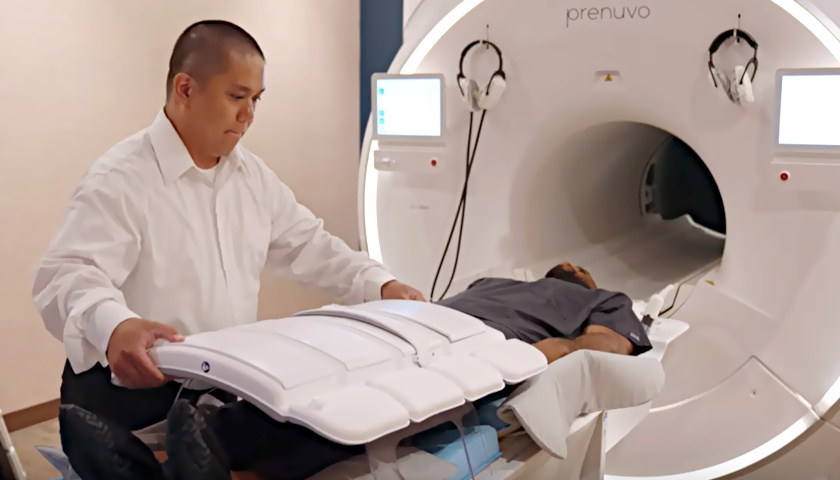
Participants are asked to limit their meals in the hours leading up to the scan, similar to preparation for surgery. After check-in, they are escorted to a dressing room to change into scrubs. Once the technicians are ready, guests are guided into a private exam room where the MRI machine is located. The technician helps position them on the table and places special scanning pads. Many are then offered the option to watch Netflix through mirrored goggles or listen to music during the exam.
A typical whole-body scan lasts 45–75 minutes; patients must remain still but can breathe normally. No needles, no claustrophobic “coffin” feel in newer wide-bore machines.
Afterwards, images go to board-certified radiologists (sometimes with AI assistance). Results arrive via secure app or portal in days to two weeks: color-coded (green/yellow/red) summaries, detailed reports, and images. Many companies offer a follow-up call or virtual consult with a physician to explain findings.
If something is flagged, the clinic may offer a referral to a third-party specialist for targeted follow-up imaging, biopsy, or monitoring.
Prenuvo emphasizes longer provider reviews with memberships; Ezra highlights speed and AI; and SimonMed leverages its hospital-like radiology infrastructure.
What These Scans Can and Cannot See
Whole-body MRI excels at detecting solid tumors (often stage 1), vascular issues like aneurysms (down to 3 mm in some cases), cysts, inflammation, and abnormalities across more than two dozen organs and regions. Prenuvo’s website says its full-body scan can detect up to 500 conditions.
But the scan’s abilities are limited to what it can “see.” Microscopic lesions, biochemical changes like pre-diabetes or early Alzheimer’s pathology, conditions needing functional or metabolic imaging, full cardiac evaluation (dedicated heart MRI or CT is better), and anything behavioral or fast-moving. GI tract screening is limited without additional preparations.
Importantly, a normal scan is not a guaranteed clean bill of health, and an abnormal one is not a diagnosis — further testing is often required.
Where Medicine Stands
Major organizations remain cautious on the topic of patient-driven, full-body scans. The American College of Radiology states it “does not believe there is sufficient evidence to justify recommending total body screening” for asymptomatic people with no risk factors or family history. It cites the lack of proven cost-effectiveness or life-prolonging benefit, plus the risk of incidental findings leading to unnecessary anxiety, testing, and procedures. Similar concerns come from other societies.
Insurance companies agree: these are elective, not medically necessary, so not covered (though HSA/FSA funds may apply). Partial reimbursement is rare.
But industry leaders like Lacy argue that traditional healthcare “prioritizes insurance systems over patients.” He notes his company’s internal data shows very low post-scan anxiety — less than 1 percent — in contrast to widespread baseline health anxiety in the general population.
Companies are collecting outcomes data hoping to demonstrate downstream savings and lives saved, much like mammograms and colonoscopies transitioned from elective to standard preventive care decades ago through evidence, guidelines, and policy shifts.
However, the evidence gap remains real. Studies show incidental, often benign findings in a wide range of about 20 percent to as high as 95 percent of people undergoing an unprescribed whole-body MRI. Most are harmless, but around 15 percent of scans prompt additional testing or follow-up.
Today, insurers and government agencies cite a lack of high-quality evidence showing net clinical benefit for on-demand whole-body MRI screening. Shifting that position would require large-scale randomized trials, updated professional guidelines, sustained advocacy, and changes in standards of care. Meanwhile, companies like Prenuvo say they are “actively working” to build their case by collecting real-world outcomes data to prove that patient-driven preventive scans can be a useful step toward healthier, longer lives.
– – –
Christina Botteri is the Executive Editor of The Tennessee Star and The Star News Network. Follow her on X at @christinakb.
Image “Full Body MRI Scan” by Prenuvo.