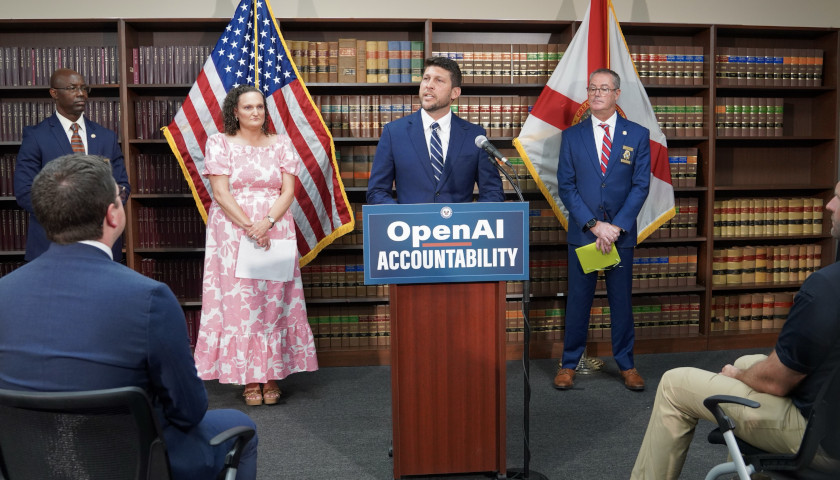
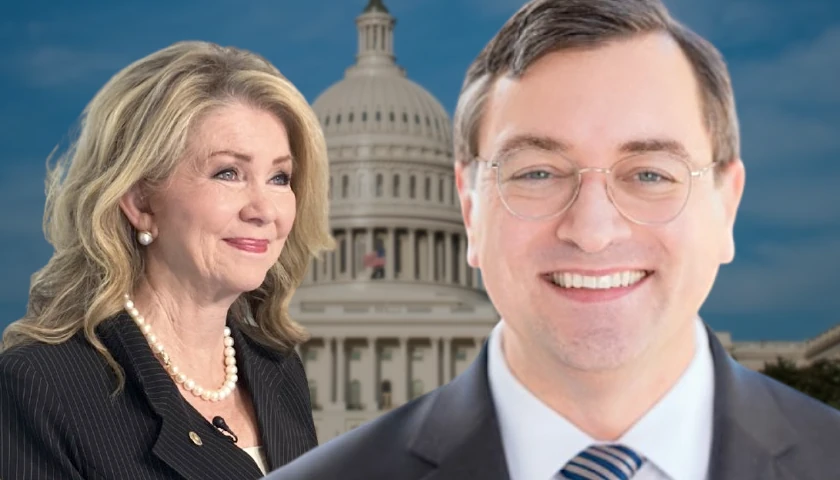
Tennessee Attorney General Jonathan Skrmetti and U.S. Senator Marsha Blackburn (R-TN) joined Senator Maria Cantwell (D-WA) and Washington Attorney General Nick Brown for a bipartisan press conference on Wednesday, urging Congress to reconsider a provision of the budget reconciliation bill, known as the “Big Beautiful Bill,” which establishes a 10-year moratorium prohibiting states from regulating artificial intelligence (AI).
Leading the press conference, Cantwell told reporters that a 10-year moratorium would block states from establishing and enforcing “laws that protect their citizens from AI harm and responsible development as AI systems,” erasing “hundreds of state laws that protect Americans from harm.”
Cantwell summarized their position, stating, “We should be fighting to protect consumers, not enabling AI theft or fraud to happen.”
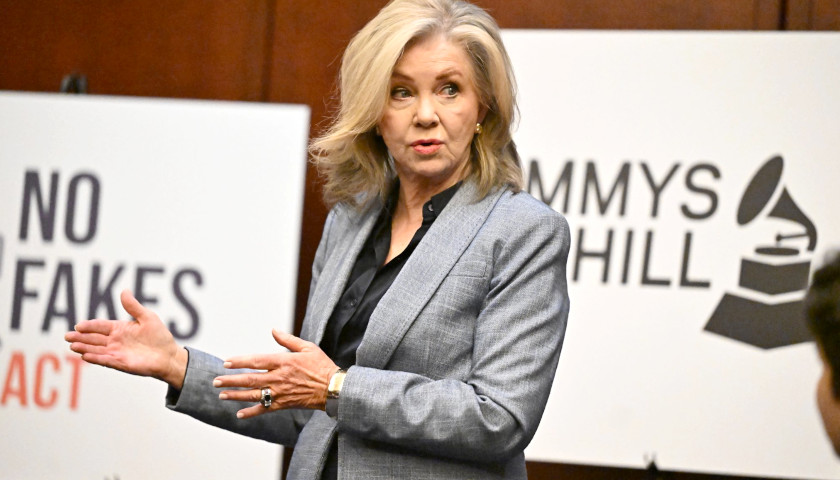
Blackburn said the moratorium would specifically invalidate the ELVIS Act, which was passed by Tennessee lawmakers and signed into law last year by Governor Bill Lee, and was written to protect the Volunteer State’s musical artists, performers, and other creative talents from having their likeness recreated by AI.
“We were thrilled when Tennessee moved forward with the ELVIS Act that would give those protections to our fabulous creative community in Tennessee. Our singers, our songwriters, our musicians, our authors, our publishers,” said Blackburn. “Having a moratorium would prohibit our state from implementing that work”
Cantwell also noted the lack of federal AI regulation, and both senators additionally questioned whether the moratorium could be legally established through the budget reconciliation process. The senator later confirmed she and Blackburn discussed the issue with the U.S. Senate parliamentarian on Wednesday.
For his part, Skrmetti called the moratorium a boon to the Big Tech companies his office is currently suing, alleging their platforms actively harm children.
“If there is a 10 year moratorium that essentially means we have 10 years when we are at the mercy of big tech,” said Skrmetti, who nonetheless called AI a “great thing,” and called for America to become the dominant AI power in the world.
He told the press, “The AI products are getting so sophisticated that there is no guarantee that we would be able to keep up using existing tools, and there would be arguments for the big tech companies that the moratorium does preclude any enforcement of any consumer protection laws if there is an AI component.”
Skrmetti, illustrating how the moratorium could impact Americans beyond Big Tech and creative professionals aided by the ELVIS Act, highlighted instances of companies allegedly using AI to artificially inflate rent prices, as well as the prices of pork, chicken, and turkey sold in grocery stores.
“Meat and poultry producers were using AI to price fix and it resulted in higher prices at the grocery store for consumers when they went to buy chicken, or turkey, or pork products,” said Skrmetti. “Or RealPage, where you had rents artificially pushed up through AI collusion.”
The attorney general also responded to concerns about potential regulatory capture, as conservatives have suggested the moratorium is necessary due to the number of Big Tech companies located in California, where Democratic officials have held a trifecta in state government since 2011.
“The more states that are looking at these issues, the harder it is to see that kind of regulatory capture, and you have more facets for potential misconduct toward consumers addressed,” said Skrmetti.
He also pointed to the slow-moving nature of Congress, suggesting that states would be able to craft AI regulations more effectively as Congress struggles to respond to the emerging technology.
“This language just leaves us completely at the mercy of tech companies, with no possible check on it, and we have to hope that Congress is going to act fast, and with tremendous respect to the senators, that doesn’t seem like a good hope to rely on,” said Skrmetti.
He added, “Without the states acting as the laboratory of democracy here, there really is nothing to stop the tech companies from doing whatever they want.”
– – –
Tom Pappert is the lead reporter for The Tennessee Star, and also reports for The Pennsylvania Daily Star and The Arizona Sun Times. Follow Tom on X/Twitter. Email tips to [email protected].
Photo “Marsha Blackburn” by Marsha Blackburn.