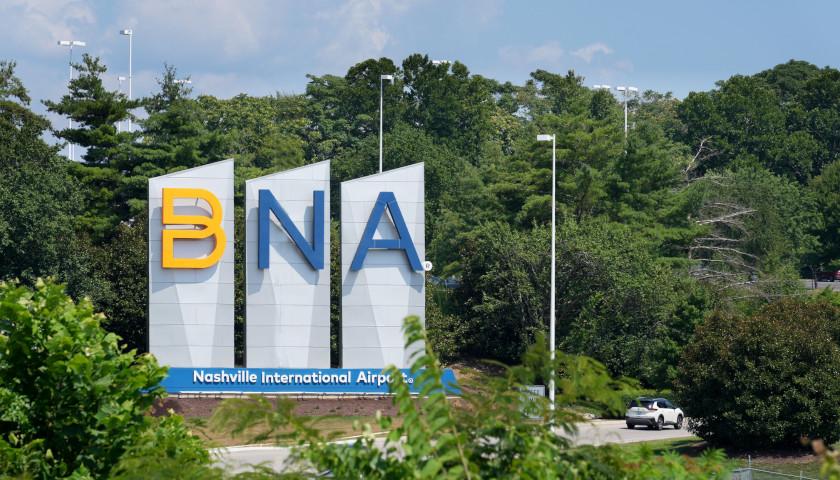
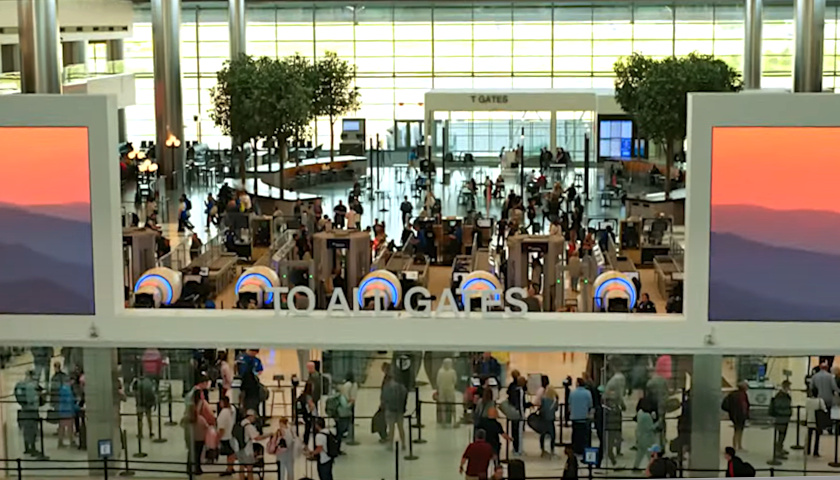
The Federal Aviation Administration issued an emergency order Thursday mandating a 10 percent reduction in domestic flights at 40 major airports nationwide, citing mounting safety concerns as air traffic controllers continue working without pay during the record-long government shutdown. Nashville International Airport (BNA) is not included on the FAA list of affected airports as of press time.
The directive, announced by Transportation Secretary Sean P. Duffy and FAA Administrator Bryan Bedford, takes effect Friday with an initial 4 percent reduction in operations, ramping up to the full 10 percent by November 14. The order will remain in place until the FAA determines conditions have improved sufficiently to restore normal operations.
“My department has many responsibilities, but our number one job is safety,” Duffy said in a statement announcing the order. “This isn’t about politics — it’s about assessing the data and alleviating building risk in the system as controllers continue to work without pay.”
In an unusual move, the FAA consulted with the Department of Justice’s Antitrust Division before issuing the order, which requires competing airlines to coordinate schedule reductions. Assistant Attorney General Abigail Slater wrote that DOJ “is not presently inclined to initiate antitrust enforcement action” against carriers complying with the order, provided antitrust counsel is present for all competitor communications.
The order also includes a critical protection for airlines: any slots not operated under these provisions will be treated as used for historic precedence, preserving carriers’ scheduling baselines for future seasons. This prevents airlines from losing valuable airport access rights during the government-mandated reductions.
The emergency order cites air traffic controller staffing constraints caused by the lapse in appropriations that began October 3, which has forced controllers to work without pay for over a month. The FAA noted that a review of voluntary safety reports from October indicated increased stress on the national airspace system, particularly at high-traffic facilities.
The order requires Part 121 and commuter air carriers to reduce their total daily scheduled domestic operations between 6 a.m. and 10 p.m. local time at each affected airport. Airlines must submit their reduction plans to the FAA on a rolling seven-day basis and face civil penalties of up to $75,000 per unauthorized flight for non-small business carriers.
The 40 affected airports include all three New York-area hubs, as well as major airports in Atlanta, Chicago, Dallas, Los Angeles, Miami, Denver, and Washington, D.C. International flights are not required to be reduced under the order, though carriers may adjust schedules at their discretion.
Nashville International Airport was spared from the mandate, though the airport noted it serves many of the affected destinations. BNA reports it moved more than 11.9 million passengers in FY2024, making it one of the nation’s busiest airports not included in the reduction order. However, Memphis International Airport is among the 40 facilities subject to cuts.
Major airlines began announcing cancellations Thursday. United Airlines said it would cancel about 200 flights daily, while Delta Air Lines canceled approximately 170 flights for Friday, American Airlines cut 220 daily flights, and Southwest Airlines canceled around 100 flights.
National Transportation Safety Board Chair Jennifer Homendy endorsed the decision, posting on social media that the action represents “safety management, the very foundation of our aviation system.” Homendy added that NTSB has repeatedly stated that low air traffic control staffing levels, mandatory overtime, and six-day work weeks have a direct impact on safety.
Nick Daniels, president of the National Air Traffic Controllers Association, said controllers received “zero dollars” in their paychecks on October 28 and warned that the financial and mental strain “increases risks within the National Airspace System, making it less safe with each passing day of the shutdown.”
The order also restricts commercial space launches and reentries to between 10 p.m. and 6 a.m. local time starting November 10, and prohibits certain visual flight operations and parachute activities near facilities with staffing issues.
Airlines will be required to issue full refunds to passengers for canceled flights but are not obligated to cover secondary costs such as hotels, which the FAA said is standard procedure when delays are not the carrier’s fault.
The government shutdown, now in its 37th day, is the longest in U.S. history. Bedford said the FAA would continue monitoring system performance and adjust restrictions as needed. “We will not hesitate to take further action to make sure air travel remains safe,” he said.
The 40 affected high impact airports include:
ANC – Ted Stevens Anchorage International Airport
ATL – Hartsfield-Jackson Atlanta International Airport
BOS – Boston Logan International Airport
BWI – Baltimore/Washington International Airport
CLT – Charlotte Douglas International Airport
CVG – Cincinnati/Northern Kentucky International Airport
DAL – Dallas Love Field
DCA – Ronald Reagan Washington National Airport
DEN – Denver International Airport
DFW – Dallas/Fort Worth International Airport
DTW – Detroit Metropolitan Wayne County Airport
EWR – Newark Liberty International Airport
FLL – Fort Lauderdale/Hollywood International Airport
HNL – Honolulu International Airport
HOU – William P. Hobby Airport
IAD – Washington Dulles International Airport
IAH – George Bush Houston Intercontinental Airport
IND – Indianapolis International Airport
JFK – New York John F. Kennedy International Airport
LAS – Las Vegas McCarran International Airport
LAX – Los Angeles International Airport
LGA – New York LaGuardia Airport
MCO – Orlando International Airport
MDW – Chicago Midway International Airport
MEM – Memphis International Airport
MIA – Miami International Airport
MSP – Minneapolis–St. Paul International Airport
OAK – Oakland International Airport
ONT – Ontario International Airport
ORD – Chicago O’Hare International Airport
PDX – Portland International Airport
PHL – Philadelphia International Airport
PHX – Phoenix Sky Harbor International Airport
SAN – San Diego International Airport
SDF – Louisville International Airport
SEA – Seattle–Tacoma International Airport
SFO – San Francisco International Airport
SLC – Salt Lake City International Airport
TEB – Teterboro Airport
TPA – Tampa International Airport
“It’s safe to fly today, and it will continue to be safe to fly next week because of the proactive actions we are taking,” Duffy said.
– – –
Christina Botteri is the Executive Editor of The Tennessee Star and The Star News Network. Follow her on X at @christinakb.
Image “Nashville Airport Security” by BNA.