A production kettle on the lower floor of Building 602 was the ignition point for the catastrophic explosion that killed 16 workers at Accurate Energetic Systems’ McEwen facility on October 10, federal investigators announced in a Friday press conference.
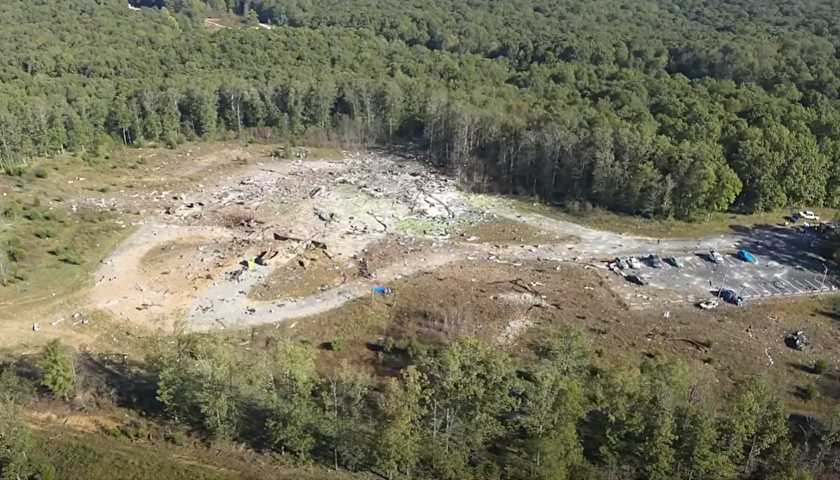
The blast, which registered as a 1.6-magnitude seismic event and was felt up to 20 miles away, originated around 7:48 a.m. in one of several large mixing vessels used to blend and heat high-explosive compounds, including precursors for TNT and RDX (cyclonite), according to details revealed Friday during a joint press briefing at the facility’s Gate 1 in McEwen. That initial detonation — estimated to involve 24,000 to 28,000 pounds of material — triggered a chain reaction, leveling the 15,000-square-foot structure and scattering debris across half a square mile, investigators said.
“The building contained a mezzanine level with six melting kettles, and the main floor contained at least three production kettles,” explained Brice McCracken, special agent in charge with the ATF’s National Center for Explosives Training and Research. The press conference was also attended by Humphreys County Sheriff Chris Davis, Hickman County Sheriff Jason Craft, ATF Special Agent in Charge Jamey VanVliet, and Tennessee Bureau of Investigation Director David Rausch.
A “kettle” in explosives manufacturing is a mixing and heating vessel used to blend, melt, and hold energetic compounds before they’re poured or pumped for casting into molds. Sizes vary widely. Off-the-shelf kettles can be as small as 10 gallons up through common production sizes in the low hundreds of gallons and even 1,000-gallon-plus industrial vessels, meaning the physical footprint can range from a benchtop unit to a floor-to-ceiling installation. Larger kettles are typically fixed in place on supports or a mezzanine.
Kettles are typically fabricated from stainless steel or specialty alloys and have a double-wall “jacket” for steam, hot water, or electric heating, plus agitators, sight ports, and discharge valves — features often tailored to the chemistry and safety requirements of the explosive being handled.
Investigators noted that facilities like AES normally operate multiple kettles rather than a single unit.
“Explosives were mixed on the mezzanine before being pumped into the heating kettles on that main floor,” McCracken said.
These kettles were essential for producing cast boosters — a mixture of TNT and RDX poured by hand into cardboard tube forms for use in commercial mining. TNT (trinitrotoluene) is a single chemical compound widely used in military and industrial explosives. It is relatively stable, can be safely melted at about 176°F for casting, and is commonly blended with more powerful explosives (like RDX).
A finished booster is placed between the detonator and the main explosive compound in order to increase (boost) the efficiency and power of the device.
McCracken noted, “In addition to those heating kettles, there were finished explosives on the main floor by the loading dock, along with a cooling area where the cast boosters were cooled prior to being packaged.”
Storage of additional explosives near a loading dock on that floor fueled the subsequent blasts, McCracken said.
The briefing, streamed live by local outlets and viewable in full at NewsChannel 5’s Facebook page, underscored the investigation’s shift from hazardous on-site recovery to forensic analysis at the ATF’s labs in Walnut Creek, California. On-site operations wrapped October 23 after 12 days, during which teams generated 290 leads, filed 277 reports, and sifted through 14,000 documents, including cell tower pings and employment logs that confirmed all 16 victims — aged 21 to 60 — were inside the building at the time of detonation.
Evidence including residue samples and equipment fragments has been shipped for testing, a process McCracken said could span months to isolate the spark that ignited the explosion — potentially from equipment malfunction, chemical instability, or human error. No foul play has been confirmed or excluded, though the ATF emphasized a “thorough and science-based” approach to assess negligence or criminality. Nearly 1,000 pounds of undetonated ordnance were safely neutralized via controlled detonations during the week-and-a-half on-scene.
The TBI’s rapid DNA system, which yields profiles in about two hours, has identified 14 victims, with next-of-kin notified. Remains for the final two — part of the initial list of presumed deceased — are unrecovered amid the debris, a revelation that visibly moved Sheriff Davis. “It breaks my heart we can’t bring two souls home,” he said.
No injuries were reported beyond the fatalities — the blast’s ferocity spared no survivors. The 1,300-acre AES complex, a key U.S. military supplier of TNT and demolition charges (including a $120 million DoD contract awarded last month), is shuttered, and its power restoration on hold due to lingering hazards. No off-site contamination has been reported as of press time, but authorities urged residents to alert officials about any debris finds. “We’re literally having to take one foot at a time,” Davis reiterated from earlier briefings, a refrain echoed Friday.
The October 10 catastrophe has revived scrutiny of AES’ safety record. A 2014 explosion at the same facility — deemed unrelated by the Tennessee Occupational Safety and Health Administration — claimed one life and injured four. More recently, 2019 OSHA citations, settled in 2023, highlighted failures in protecting workers from RDX exposure, including allegations of inadequate training and unclean break areas contaminated with the explosive powder.
The October 16 wrongful death lawsuit filed in Humphreys County Circuit Court on behalf of 9-year-old “P.M.” and her mother, Cheyanne Towry, seeks up to $12 million against parent company AAC Investments, LLC, for alleged gross negligence. Attorneys from Hughes & Coleman, partnering with Texas explosion specialists, have fielded consultations from other families but filed no additional suits yet. According to Tennessee civil procedure rules, AAC has until mid-November to respond.
Located in rural Humphreys and Hickman counties, AES employed about 80 local residents. Services, vigils, and other gatherings continue as the community begins the slow process of healing. Sheriff Davis, citing families “overwhelmed by Facebook people,” urged privacy for those awaiting closure on two unidentified victims.
A GoFundMe page has raised a little more than $47,000. Separately, the Community Foundation of Middle Tennessee is actively collecting donations. Both efforts say funds “will help meet immediate needs first, such as funeral expenses, medical care, housing and food assistance. Contributions will also be used to offer long-term support, such as counseling services for AES employees and surviving family members.”
– – –
Christina Botteri is the Executive Editor of The Tennessee Star and The Star News Network. Follow her on X at @christinakb.
Image “AES Blast Site” by Humphreys County Emergency Management Agency.