
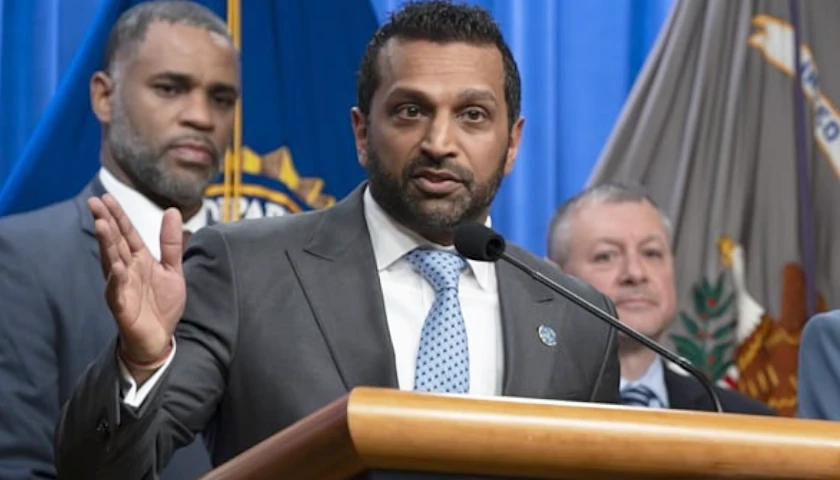
The Tennessee Star‘s CEO and editor-in-chief, Michael Patrick Leahy, and lead reporter Tom Pappert argued FBI Director Kash Patel’s lawsuit against The Atlantic could become a pivotal test of both defamation law and modern journalistic standards, centering on whether the outlet’s reliance on anonymous sources and its alleged failure to address pre-publication rebuttals rise to the level of “reckless disregard for the truth.”
During Wednesday’s edition of The Michael Patrick Leahy Show, Leahy and Pappert discussed the legal standard set by New York Times Co. v. Sullivan, which requires public officials to prove “actual malice” in defamation cases.
Leahy emphasized that Pappert’s reporting on Tuesday laid out how the circumstances surrounding the Atlantic article, particularly the outlet’s alleged failure to address a detailed pre-publication letter disputing its claims, could provide a potential pathway for meeting that burden.
He highlighted Pappert’s conclusion in his Tuesday report that The Atlantic’s actions could demonstrate “reckless disregard of whether it was false or not.”
Pappert underscored the importance of a pre-publication letter sent by Patel’s legal team, which he said identified numerous factual disputes before the story was published.
According to the lawsuit, the outlet failed to engage with those claims.
As Pappert recounted, Patel alleged, “They did not acknowledge the publicly available counter-evidence identified therein. They did not retract or modify the false statements identified. They made no meaningful response at all.”
Leahy further noted that if the lawsuit survives early procedural challenges, it could open the door to discovery of internal editorial communications.
Citing Herbert v. Lando, he pointed out that “internal communications occurring during the editorial process are not protected by the First Amendment,” potentially allowing Patel’s legal team to examine how the article was developed.
Beyond the legal questions, Pappert raised concerns about the publication’s use of anonymous sources, arguing that it appears to diverge from widely accepted journalistic standards. He referenced guidance from the Society of Professional Journalists, which advises reporters to “consider sources’ motives before promising anonymity” and to reserve such protections for individuals facing danger or retribution.
Pappert contrasted this with policies from National Public Radio, which state that anonymous sources should “rarely be heard at all, and should never be heard attacking or praising others in our reports,” with limited exceptions.
He also cited a 2016 letter from editors at The New York Times acknowledging that anonymous sourcing, while sometimes necessary, has in some instances led to reporting that “has turned out to be wrong.”
In this case, Pappert noted, The Atlantic justified granting anonymity to its sources “to discuss sensitive information and private conversation,” a rationale he suggested falls short of the stricter criteria outlined by industry guidelines.
Pappert also detailed his attempt to obtain clarification from the publication, saying he posed several questions about whether it received Patel’s letter, whether it maintains a formal editorial policy, and how it governs the use of anonymous sources.
The response, he said, was insufficient.
“[They] said you may already have this, but flagging our statement for Monday. That was it,” he said. “[That statement] did not even begin to address our questions. I suppose you could argue that it addressed…that they stand by the reporting, but none of the specifics were answered. No effort and no explanation for why there was not an effort.”
Leahy highlighted that the outlet did not directly answer those questions, while Pappert described the reply as “a complete non-answer.”
Looking ahead, Pappert suggested the case could evolve significantly as it progresses, particularly if discovery reveals internal deliberations.
“What were they saying in the newsroom after his lawyer sent that four-page letter with the 19 corrections to their statements of fact?” he asked, adding that such details could prove consequential.
He predicted that The Atlantic may ultimately reconsider its position, stating, “I think The Atlantic is going to change [its] position within six months and probably settle with Kash Patel.”
Leahy, meanwhile, argued that the case is likely to face early motions to dismiss but could advance through appeals if necessary.
He maintained that the reliance on “24 anonymous sources with scurrilous claims with no evidence to support it… meets the reckless disregard standard,” though he acknowledged that courts will ultimately decide the issue.
Pappert concluded that the dispute could extend well beyond the trial court level, noting that existing precedent leaves room for interpretation.
“This is an unsettled issue,” he said, adding that if Patel “really wants that $250 million,” there is “no reason to think that he’s not going to pursue the appellate path… as long and as hard as he can.”
Tune in now to The Michael Patrick Leahy Show – your AMERICA FIRST news talk!
– Watch LIVE here on X
– Watch LIVE on YouTube / Rumble / Roku / AppleTV
– Listen on Spotify
– Listen on WENO AM760 in Nashville
– Read more at @TheTNStarhttps://t.co/8AJJfNY1cp— Michael Patrick Leahy (@michaelpleahy) April 22, 2026
– – –
Kaitlin Housler is a reporter at The Tennessee Star and The Star News Network. Follow Kaitlin on X / Twitter.
Photo “Kash Patel” by the FBI.