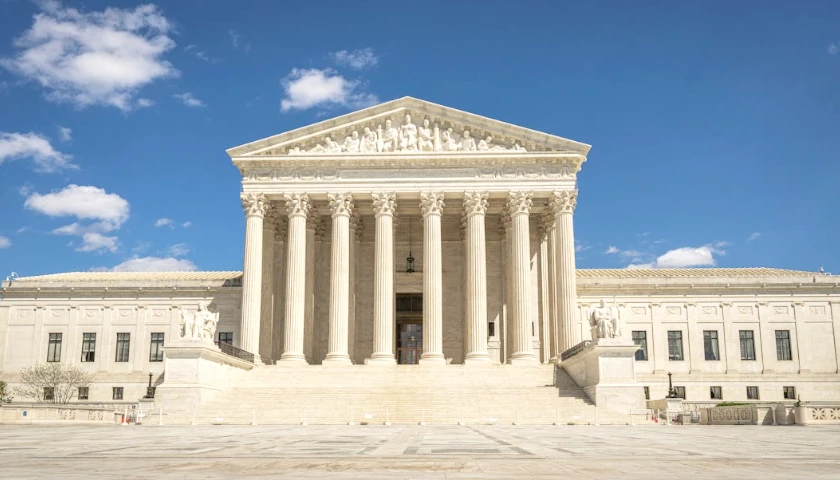

In an unsigned order issued late Monday, the Supreme Court ordered its April 29 decision in the case Louisiana v. Callais (No. 25A1197), which placed new limits on a key provision of the Voting Rights Act, to take effect immediately. The ruling bypasses the court’s usual 32-day waiting period and clears the way for Louisiana to pursue new congressional maps before the 2026 midterm elections.
The move accelerates the return of the case to a lower court, where officials say they will move quickly to redraw districts.
The underlying 6-3 ruling, written by Justice Samuel Alito, struck down Louisiana’s map — which included two majority-Black congressional districts — as an impermissible use of race under the Equal Protection Clause of the 14th Amendment. The court held that Section 2 of the Voting Rights Act of 1965 does not require states to create additional majority-minority districts when doing so would subordinate traditional race-neutral districting principles.
Justice Elena Kagan dissented in the main case, joined by Justices Sonia Sotomayor and Ketanji Brown Jackson, arguing the decision effectively renders Section 2 “all but a dead letter.”
In a separate dissent on the expedited mandate, Justice Jackson accused the majority of contributing to “chaos” in Louisiana’s ongoing election process.
She wrote that the Court’s decision “has spawned chaos in the State of Louisiana” and warned that by issuing the judgment forthwith, the majority was taking steps “to influence its implementation” and appearing to endorse “Louisiana’s rush to pause the ongoing election in order to pass a new map.”
Justice Alito, joined by Justices Clarence Thomas and Neil Gorsuch, filed a concurrence defending the order.
“The dissent would require that the 2026 congressional elections in Louisiana be held under a map that has been held to be unconstitutional,” Alito wrote. He argued that the dissent offered “two reasons for its proposed course of action. One is trivial at best, and the other is baseless and insulting.”
Under Supreme Court Rule 45.3, the clerk typically waits 32 days before issuing the formal judgment to allow time for rehearing petitions. Louisiana did not oppose the request to issue the judgment “forthwith,” and the challengers who lost in the main case did not signal plans to seek rehearing.
The state’s congressional primaries are currently scheduled for May 16, but Gov. Jeff Landry, a Republican, has signaled plans to delay them to allow time for a new map. Republican lawmakers control the state Legislature and are expected to draw a map with only one majority-Black district.
Civil rights groups and Democratic leaders condemned the pair of rulings as a severe blow to minority voting power. The NAACP called the original decision a “devastating blow” to the Voting Rights Act, while the Congressional Black Caucus described it as “the death certificate” for the landmark 1965 law.
Meanwhile, Republican officials and conservative legal advocates welcomed the outcome. Louisiana Republicans said they will comply with the ruling and move swiftly to redraw lines, potentially gaining an additional House seat in the November midterms. Similar moves are already underway in other states, including Florida, where lawmakers approved a new map hours after the April 29 decision.
Legal experts said the broader impact of the April 29 ruling will likely be felt most strongly in future redistricting cycles, particularly following the 2030 census. Most filing deadlines for the 2026 congressional races have already passed in many states, making immediate map changes logistically difficult outside Louisiana.
The landmark case originated from a 2022 map drawn by Louisiana after the 2020 census. Black voters sued, arguing the map diluted their voting strength by packing them into a single district rather than creating a second majority-Black seat. A federal district court initially blocked the map, but the Supreme Court’s intervention set the stage for the final 6-3 decision.
The three-judge panel that previously struck down the map will now oversee the remedial phase. Louisiana’s Republican-controlled Legislature is expected to have the first opportunity to enact a new congressional map that complies with the Supreme Court’s ruling by avoiding predominant use of race in drawing district lines. Legal observers anticipate this would result in a plan featuring only one majority-Black district — restoring something closer to the pre-2024 configuration — which could shift the state’s congressional delegation from its current 4-2 Republican advantage to as much as 5-1 or 6-0.
If the Legislature fails to produce an acceptable map on a court-approved timeline, the district court could impose its own remedial plan, potentially drawn with input from experts or special masters. As state officials have said they will move quickly, the Legislature retains authority to adjust filing deadlines and primary dates to accommodate new boundaries for the 2026 elections.
– – –
Christina Botteri is the Executive Editor of The Tennessee Star and The Star News Network. Follow her on X at @christinakb.