by Ireland Owens
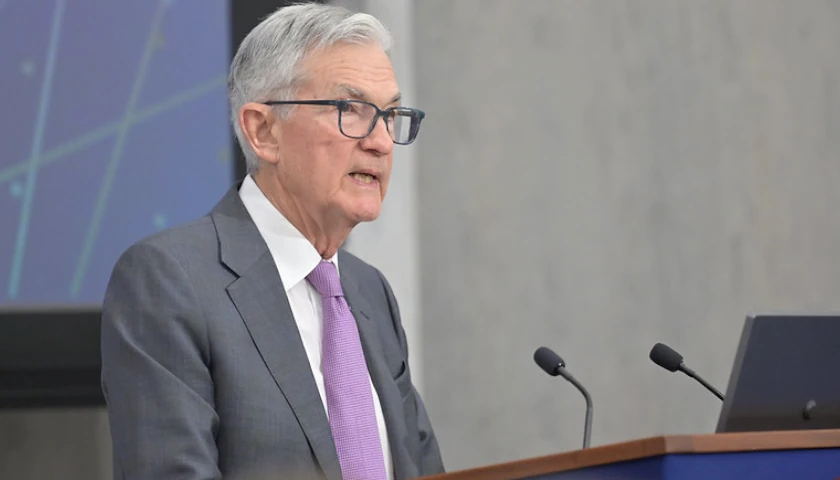
Federal Reserve Chair Jerome Powell suggested Tuesday that the central bank may be on track to lower its interest rate target range again in 2025.
Powell said in a speech at an event hosted by the National Association for Business Economics that based on data currently available amid the ongoing government shutdown, “it is fair to say that the outlook for employment and inflation does not appear to have changed much” in the past four weeks. His comments appear to signal that the Fed is on track to make more rate cuts in the future after lowering its target range in September.
Though, Powell said that economic data available before the start of the shutdown indicates that “growth in economic activity may be on a somewhat firmer trajectory than expected.” The Fed chairman also stressed that the “downside risks to employment appear to have risen” amid a somewhat softening labor market.
 “While the unemployment rate remained low through August, payroll gains have slowed sharply, likely in part due to a decline in labor force growth due to lower immigration and labor force participation,” Powell said. “In this less dynamic and somewhat softer labor market, the downside risks to employment appear to have risen. While official employment data for September are delayed, available evidence suggests that both layoffs and hiring remain low, and that both households’ perceptions of job availability and firms’ perceptions of hiring difficulty continue their downward trajectories.”
Powell also warned that there is no “risk-free path for policy” for the Fed to take as it continues to navigate the “tension” between its goals related to employment and inflation.
“Rising downside risks to employment have shifted our assessment of the balance of risks. As a result, we judged it appropriate to take another step toward a more neutral policy stance at our September meeting,” Powell said.
“I will stress again that these projections should be understood as representing a range of potential outcomes whose probabilities evolve as new information informs our meeting-by-meeting approach to policymaking,” he continued. “We will set policy based on the evolution of the economic outlook and the balance of risks, rather than following a predetermined path.”
In September, Powell similarly asserted that the central bank is currently facing a “challenging situation” due to inflation risks and recent weak employment data.
This year, Trump has pressured Powell to lower interest rates on numerous occasions. Trump rebuked Powell in April, saying his resignation couldn’t come soon enough after he did not lower interest rates. The following month, Trump met with Powell to attempt to get him to lower interest rates. White House Press Secretary Karoline Leavitt said the president thought Powell was making a mistake by not lowering interest rates.
In June, Trump posted on Truth Social, stating Powell needed to lower interest rates. The president referred to the Federal Reserve Chair as “Too Late” Powell. Later on in June, Trump gave Powell a handwritten note, criticizing him for not lowering interest rates.
Trump said in July, after months of threatening to fire Powell, that he was “unlikely” to do it.
– – –
Ireland Owens is a reporter at Daily Caller News Foundation. Zachery Schmidt is the digital editor of The Star News Network and contributed to this story.