by Michael S. Kochin
Let me be blunt: since the Wehrmacht’s surrender in Tunisia in 1943, the African continent has offered the United States almost nothing of major consequence to its national interest. Our engagement since has been a costly, sentimental fog of humanitarian gestures and posturing, achieving little while ignoring the realities of power.
Washington’s central failure is its refusal to see the continent as it is. There are two successful models for order that have worked over large portions of Africa. The first is the default of Muslim rule. This system, even at its most functional, offers a brutal and usually racist order that threatens to return to its foundations of slavery and massacre. It offers only occasional and temporary alignments with Western interests and is utterly incompatible with Western values.
The second real-world alternative is colonialism. This, at least, offers a framework for the values the United States claims to export—property rights, the rule of law, and functional infrastructure. However, America lacks both the will and the capability for such a project. Witness the blood-soaked two-century history of Liberia, nominally sovereign but in reality the United States’ only African colony. As John Stuart Mill, formerly a clerk of the East India Company, once wrote, the British Empire was “a vast system of outdoor relief for the British upper classes.” The US has never had an upper class big enough even to staff its embassies, much less to spare to rule great swathes of Africa with breeding, ability, and frigid hauteur.
The one truly successful American intervention in Africa since 1942’s Operation Torch landings was the 1994 dispatch, or “facilitated departure,” of Paul Kagame. Kagame, nominally an officer in the Ugandan Army and in reality commander-designate of the Rwandan Patriotic Front, was allowed to leave a course at Fort Leavenworth to take command of his force in what turned out to be, thanks to his leadership, the final offensive of the Rwandan Civil War. Kagame is no Jeffersonian democrat. He is a ruthless, efficient, and intelligent ruler who understands power. He did what the posturing of the “international community” could not: he ended a genocide. In its ashes, he built one of the continent’s most stable, secure, and least corrupt nations. His critics are, of course, many. They will bring up his authoritarian methods and, most pointedly, his actions in the Democratic Republic of the Congo. But this is precisely the point. Kagame has not been so foolish as to rule the bottomless chaos of the Congo. He simply does what any right-thinking and patriotic foreign actor would: he exploits Congo’s disorder for the benefit of his country of Rwanda. This is not morality; it is the cold, rational, and successful pursuit of Rwanda’s national interest. It is a model.
The true test for this model, and for America’s capacity for strategic realism, lies in West Africa. Nigeria—the continent’s demographic and economic giant—is perpetually on the brink of collapse, torn apart along religious and ethnic lines by corruption and jihad. It is, to put it mildly, a bit far and a bit large for the actual Kagame to bite off, even now that Mr. Trump has seemingly brokered an end to the fighting in the Congo.
What is needed is a Nigerian Christian Kagame. The folly of Iraq and Afghanistan has proven that American fighting troops cannot, and must not, be the solution. What is required is a local strongman who can rise from the chaos, secure the state, and win the inevitable civil war that is necessary to forge a nation.
America’s role in this should be ruthlessly pragmatic and detached. We must identify this potential leader and provide the technical aid, the intelligence, and the weapons to ensure he wins. This is the only way for the United States, with its technological might and its human capital defects, to secure a stable partner in a region that threatens to export only terror and refugees.
This is the hard truth of African geopolitics. The stability America desires will not come from NGOs, humanitarian aid, or lectures on democracy. It can only come from a local strongman with the will to power, backed by American technology.
The problem, as the last 80 years have shown, is that in all of post-colonial African history, there has been only one Kagame.
– – –
Michael S. Kochin is Professor Extraordinarius in the School of Political Science, Government, and International Relations at Tel Aviv University. He received his A.B. in mathematics from Harvard and his M.A. and Ph.D. in political science from the University of Chicago. He has held visiting appointments at Yale, Princeton, Toronto, Claremont McKenna College, and the Catholic University of America. He has written widely on the comparative analysis of institutions, political thought, politics and literature, and political rhetoric. With the historian Michael Taylor he has written An Independent Empire: Diplomacy & War in the Making of the United States (University of Michigan Press, 2020).
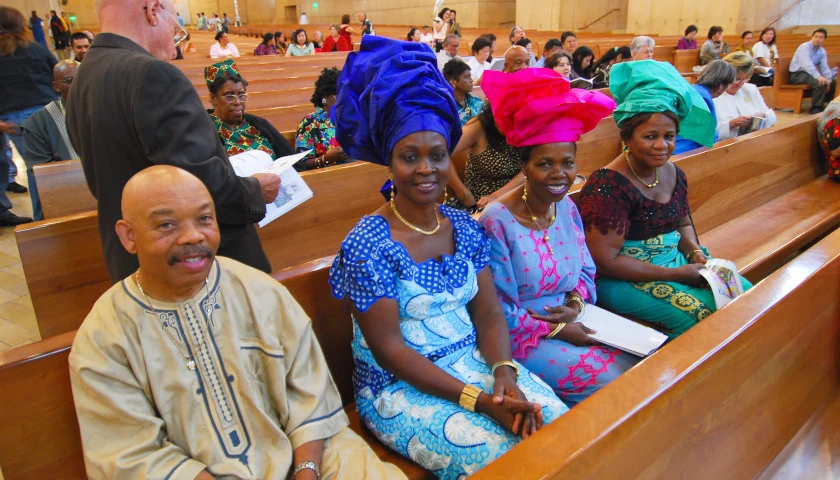
Photo “Nigerian Catholics” by Eric Chan. CC BY 2.0.