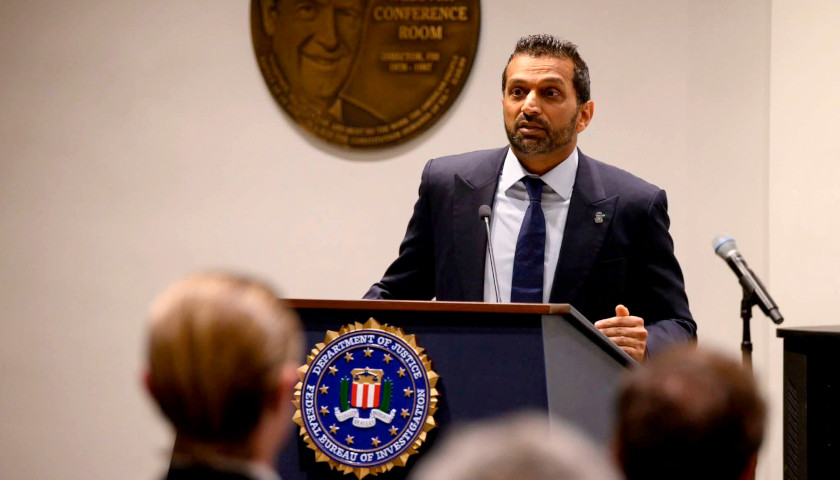
The Atlantic on Thursday doubled down on its claims that FBI Director Kash Patel has a serious drinking problem that impacts his job performance during an episode of the magazine’s podcast. The publication reasserted the claims it originally reported on April 17, claimed that new, anonymous sources have since emerged, and added that reports indicating Patel had a problem with abusing alcohol first emerged prior to his February 2025 confirmation by the U.S. Senate.
Nearly a week following the April 17 report about Patel, and after the director filed a $250 million lawsuit against The Atlantic and reporter Sarah Fitzpatrick, the journalist was interviewed for the publication’s program, Radio Atlantic, which was transcribed by the magazine for an article titled, “The Kash Patel Fallout.”
In her interview, the journalist offered new information about the two dozen anonymous sources she reported were interviewed for the article, describing them as “people who felt that not only was this conduct embarrassing, unbecoming, but that it was a national-security vulnerability and that Americans were perhaps less safe as a result.”
The anonymous sources were additionally described as “current and former FBI officials, Justice Department officials, people close to the White House, people who are involved in intelligence agencies, people who are lawyers, lobbyists, hospitality workers” during the program.
Fitzpatrick stated, “I had never heard anything like this as a reporter, and I think I spent a very long time, a very diligent amount of time checking it out because it was so explosive.”
The reporter additionally claimed more sources approached her after publication, but did not indicate whether any were willing to go on the record.
“Since the moment that I published this story, I have been inundated, truly inundated, with new sourcing that goes to the highest levels of the government, who are offering corroborating information,” said Fitzpatrick. “So if you’ve reached out to me and I haven’t gotten back to you, it’s because I just haven’t made it there yet. But I am going to call you—don’t worry.”
The Society of Professional Journalists (SPJ) notably advises against promising anonymity to sources unless the information they possess cannot be reported otherwise or would leave them open to retribution, danger, or harm. Should anonymity be offered, SPJ urges reporters to explain their decision.
Fitzpatrick also divulged for the first time that she first heard claims about Patel’s drinking before his confirmation.
“I began hearing concerns about Patel even before he became the FBI director, before his nomination and then during his nomination,” she said during her appearance on Radio Atlantic. “I would say that the frequency and intensity of those concerns has increased exponentially, and particularly since the beginning of the Iran war.”
This claim notably contradicts the on-record denial by Clint Brown, the former U.S. Senate staffer who served as “Sherpa” to Patel during the transition to the Trump administration and confirmation process, who told The Tennessee Star on Monday that he saw no evidence of alcohol abuse during the three months he spent in close proximity to the director.
“I never saw anything like that. You know, it was breakfast, lunch and dinner together every day. If there were anything like that, I would’ve seen it,” said Brown. “I knew when the guy went to bed. I knew when he got up in the morning because we were working all through the night. There’s just no possible way.”
He told The Star, “Most days I’d see Kash more than my family. We were together from 7:30 a.m. until eight or ten at night, and then I would go home, log on, and begin working on materials for the next day, send those to him in the middle of the night, and then he’d be responding back and forth on those materials, and then do it all again the next day.”
Patel filed his $250 million lawsuit against The Atlantic and its reporter on Monday. It is assigned to U.S. District Judge Emmet G. Sullivan, who drew controversy after he refused to grant the U.S. Department of Justice’s request to drop its case against former national security advisor Michael Flynn.
The Atlantic confirmed on Monday that it intends to defend its reporting.
– – –
Tom Pappert is a 2025 recipient of the Dao Prize and the lead reporter for The Tennessee Star. He also reports for the Star News Network. Follow Tom on X. Email tips to [email protected].