
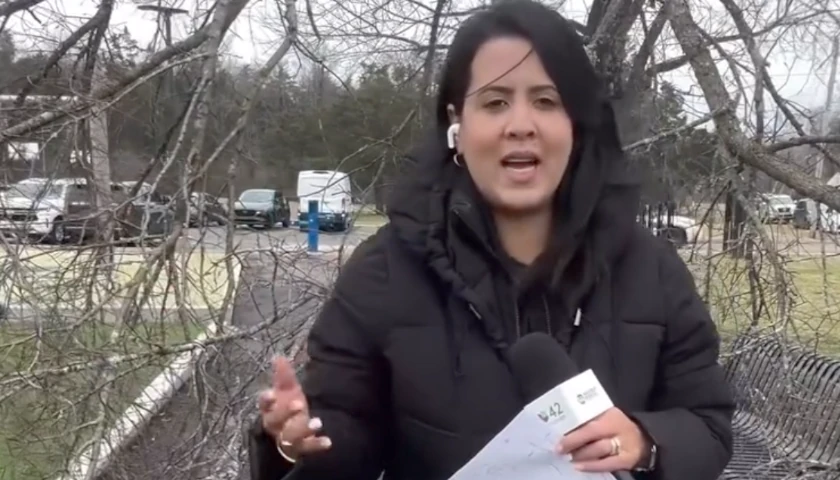
Federal attorneys in Middle Tennessee on Thursday submitted their response to the habeas corpus lawsuit filed by Estefany Rodriguez Flores, the Colombian journalist detained by U.S. Immigration and Customs Enforcement (ICE) in Nashville, who has claimed her arrest violated the First, Fourth, and Fifth amendments of the Constitution.
In its response to the complaint, requested by U.S. District Court Judge Eli Richardson ahead of a March 17 hearing, the U.S. Department of Justice (DOJ) began by claiming that Rodriguez Flores misrepresented the circumstances of her arrest to the court in support of her Fourth Amendment argument.
“Petitioner, on March 4, 2026, filed her original Petition that included in the heading ‘Emergency,’ and alleged that she was taken into custody without a warrant,” wrote the federal attorneys. “That is simply not true.”
According to the DOJ, Rodriguez Flores “was arrested pursuant to a valid arrest warrant, lawfully detained, and she has clearly misrepresented the facts in her original petition.”
It also told the court that Rodriguez Flores’ lawsuit, as submitted by attorney Joel Hugh Coxander, incorrectly relies on the Federal Rules of Criminal Procedure, which do not apply to a civil immigration case.
In response to her Fifth Amendment claims, the DOJ highlighted the administrative options still available to Rodriguez Flores and asked Richardson to dismiss her habeas corpus lawsuit, as she had not exhausted these avenues.
Among the remedies available to Rodriguez Flores prior to filing the lawsuit was a bond hearing, and, according to the DOJ, Rodriguez Flores requested and was granted one after filing the petition. Her bond hearing is now scheduled for March 16.
If Rodriguez Flores is denied bond, the DOJ notes she will be able to appeal the decision to the Board of Immigration Appeals, as part of her due process in immigration court.
Rodriguez Flores additionally amended her complaint to include a First Amendment violation, claiming she was detained as retribution for her critical reporting of ICE activity in Nashville.
According to the DOJ, Rodriguez Flores failed to provide evidence supporting this claim, and contrary to targeting her for her speech, ICE authorized the warrant for her arrest two days prior to her encounter with agents. It was issued because Rodriguez Flores illegally overstayed after entering the country on a tourism visa in 2021 and failed to respond to two Call-In Letters sent by ICE earlier this year.
It also notes that ICE issued the first Call-In Letter, or G-56 letter, on January 8, requesting Rodriguez Flores appear at the ICE Field Office on January 26.
She married her husband, a U.S. citizen, on January 21, but missed the January 26 appointment due to Winter Storm Fern.
A second G-56 was sent on February 10, requesting her to appear on February 25. When Rodriguez Flores did not appear at the ICE office for her appointment or communicate with the field office after receiving either letter, the administrative warrant for her arrest was issued on March 2. She was arrested on March 4.
In addition to their response to her constitutional claims, the DOJ told Richardson that Rodriguez Flores’ lawsuit failed to properly name a defendant, as required in a habeas corpus lawsuit.
“Further, there is no properly named Defendant,” cited the DOJ, arguing that federal immigration law specifies the only proper defendant is the ICE Field Office Director who is in custody of Rodriguez Flores.
“The only proper Defendant to Petitioner’s allegations is the Field Office Director of Enforcement and Removal Operations, New Orleans Field Office, who has not been named,” wrote the DOJ attorneys. “Except in extraordinary circumstances, the only proper respondent in a habeas corpus case is the detainee’s immediate custodian.”
According to the DOJ, ICE Enforcement and Removal Operations official Scott Ladwig is named incorrectly, while the lawsuit also names DHS Secretary Kristi Noem, the Department of Homeland Security, and ICE’s Nashville field office as defendants. Noem will leave the agency at the end of this month.
Another filing in the lawsuit recently revealed that the January 8 letter from ICE informed Rodriguez Flores that the meeting was called to issue her a Notice to Appear, or Form I-862, which is generally used to justify removal proceedings.
– – –
Tom Pappert is a 2025 recipient of the Dao Prize and the lead reporter for The Tennessee Star. He also reports for the Star News Network. Follow Tom on X. Email tips to [email protected].
Photo “Estefany Rodriguez Flores” by Estefany Rodriguez Flores.



Surely this Tennessee “journalist” would not misrepresent such details.
Must be ICE just causing trouble for this upstanding migrant.