
by Teresa R. Manning and Ian Oxnevad
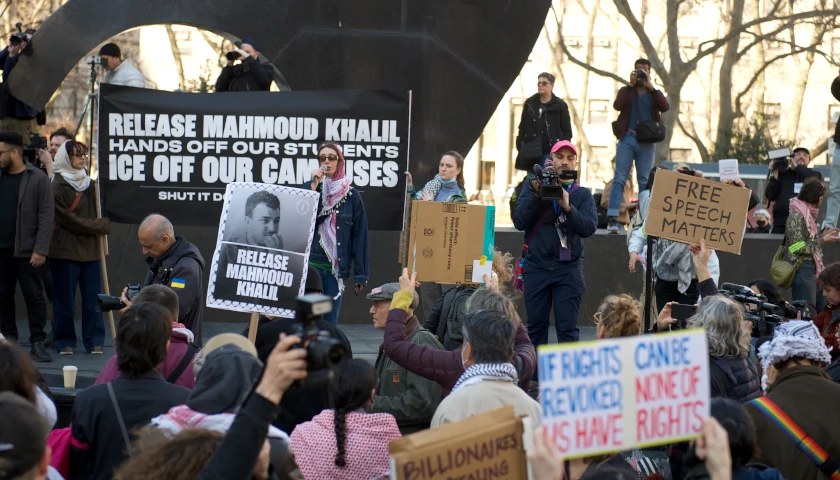
On September 30, 2025, a federal trial court in Massachusetts found that the Trump Administration violated the First Amendment in March when it moved to detain and deport Mahmoud Khalil, a former visa student at Columbia University. The case was brought by the American Association of University Professors (AAUP) and the Middle East Studies Association, among other professional groups, whose members claimed Khalil’s arrest chilled their expression rights. Khalil had participated in many campus protests about the Middle East; New Hampshire District Court Judge William Young said the case was “perhaps the most important ever” for his court.
Unfortunately, his opinion blurred the distinction between citizen and non-citizen, further eroding America’s self-governance. The decision will almost certainly be appealed, however, so this story is far from over.
What’s more, Khalil’s situation is further complicated by other court cases and court actions, including a deportation order issued by a Louisiana immigration judge earlier in September. There, Judge Jamee Comans found that Khalil had “willfully misrepresented material facts” when he applied for his student visa and his green card, all to circumvent the immigration process. Comans’ opinion will also undoubtedly be appealed, confirming statements by Khalil’s lawyers that this means “a long legal fight ahead.”
Mahmoud Khalil is a 30-year-old Algerian/Palestinian, though he was born and raised in Damascus, Syria. He came to the United States in 2022 on a foreign student visa to attend Columbia’s graduate program in International and Public Affairs. He obtained a green card in 2024.
Columbia has been the site of many high-profile protests about the war in Gaza, which started after the terrorist attacks on Israel on October 7, 2023. (Columbia has a well-known program on Middle Eastern Studies, which attracts scholars and students from that region—perhaps the reason its campus has had so much turmoil.) Thousands have been injured and killed on both sides of the war, though Gaza has suffered more civilian deaths—hence the demonstrations. But protesters go further than objecting to civilian casualties; they also defend and rationalize terrorist acts, including those carried out on October 7 by Hamas, an organization long designated as a terrorist by the United States State Department.
Rationalizing terrorism is bad enough. But protesters go further, singling out Jewish students—not Israeli government officials—as culprits and bad actors, chanting “divest or death,” and blocking entrances to classrooms, libraries, and residence halls. Many wear black masks. Needless to say, this creates a climate of intimidation and hostility for these students, compromising their educational opportunities. As a result, numerous lawsuits have been filed not just against Columbia but also against other schools, claiming those schools have failed to secure equal access to education for all students.
Khalil was actually no longer a student at the time he was detained. Instead, he was working to secure employment with the non-governmental organization OXFAM. Notwithstanding, he served as lead negotiator to Columbia on behalf of pro-Palestinian protesters in 2024. He is also alleged to have ties with Hamas, which was not disclosed on his application for a student visa or green card, the grounds cited by the Louisiana immigration court in its order to deport him.
Khalil’s case is now known internationally because of its implications for free speech and assembly. At least three lawsuits about him are pending—not just in Massachusetts and Louisiana, but also his own lawsuit filed in New Jersey.
Judge Young’s opinion reviews the First Amendment allegations against Trump as well as the administration’s defenses: Complainants say that Secretary of State Marco Rubio and other officials violated Khalil’s free expression rights when they detained him because the actions were in response to (or retaliating for) the expression of his political views, ordinarily protected speech. They claim the free speech rights of others—including faculty members—are also chilled by these governmental actions. According to the Court, many professors testified to that effect during a 9-day bench trial, saying they were refraining from speaking since Khalil’s arrest. No jury was involved.
For most Americans, however, the issue of greatest importance in Khalil’s case might not be free speech or terrorism, as compelling and legitimate as those concerns are. Instead, they might care most about the more threshold question: Do non-citizens enjoy the same rights as citizens, especially First Amendment rights? Should they?
Judge Young’s opinion states unequivocally, “[Y]es, they do … the First Amendment does not draw President Trump’s invidious distinction [between citizens and non-citizens];” the rights, freedoms, and “limits are the same for both citizens and non-citizens alike.”
With all due respect, these statements cannot be correct. Non-citizens cannot vote, for example, nor can they serve on juries. Obviously, the rights and freedoms of citizens differ from those of non-citizens, and First Amendment law should reflect that.
A panel at a recent conference sponsored by the Federalist Society and the Defense of Freedom Institute discussed some of these issues, emphasizing that non-citizens within the U.S. have considerably more rights than non-citizens seeking entry—one reason federal officials stress the importance of vetting and also the reason that fraud to gain entry can mean deportation once here, as the Louisiana immigration court reasoned. However, many areas of law are less settled than the distinction between entering the country and being already present.
So how much free speech protection should extend to non-citizens?
The exact degree matters less than the principle that non-citizens do not have the same constitutional rights as citizens. Non-citizens are guests. Like all guests, they have the benefit and comforts of the home they’re visiting. But guests are not family members. No guest should rummage through the refrigerator the way the kids of the household might.
The Khalil case may get resolved with his deportation because he withheld information from his visa and green card applications. But the legal, constitutional, and political issues will remain as America continues to grapple with out-of-control immigration and the possible dilution of citizen rights that results.
In electing President Trump, Americans arguably voted just last year not just for a fortified border but also mass deportations precisely to restore the country’s self-governance—specifically, that citizens get to decide who comes into the country and who has constitutional rights, such as the right to free speech and to what degree.
For that reason, the Khalil case for many Americans is about citizenship and American sovereignty as much as anything else.
– – –
Teresa R. Manning is Policy Director at the National Association of Scholars, President of the Virginia Association of Scholars, and a former law professor at Virginia’s Scalia Law School, George Mason University. Ian Oxnevad is a senior fellow of foreign affairs and security studies at the National Association of Scholars.
Photo “Mahmoud Khalil Supporters” by SWinxy. CC BY 4.0.



Why should we allow non citizens to come to this country and bad mouth our system of government, our opinions of world situations and cause strive among the citizens???
If you’re not a citizen, your opinion is like your vote, “NOT ALLOWED”.
I think we need to “EXPORT” some of these liberal UN American opinionated Judges.
Personally, I’m getting “pissed” at some of these Judges giving more consideration to “Foreigners” than Citizens.
Illegals and non citizens DO NOT have the full cover of our Constitution. We cannot kill them or beat them up but they do not have full protection of the Constitution nor do they have the same rights. Any laws passed that gave them protection under the Constitution is in itself a violation of the Constitution and is null and void of law. That includes providing the children of these people an education. If one were to read the Senate Debate of 1866 (2 years before the 14th was passed under duress) it lays out very clearly the components of the 14th. It also clearly says if you are born on US soil you are a citizen but not if your parents were foreigners. The 14th was to address the citizenship of the recently freed slaves, Indians, Chinese in CA and Gypsies in PA. It also talks about due process and all other components of the 14th. Nothing but an amendment to the Constitution can change the original intent of the Constitution. We have allowed our education system to dumb down the American people so those with an agenda can twist the Constitution to a dumbed down society that has no clue about our founding documents and the fact that the Constitution puts restrictions on the federal government not the states or the people of the states. One needs to read, research and understand Art. 1 Sec. 8, Sec. 9, Sec. 10. The 9th and 10th Amendment. There is no clause in the Constitution that expands the powers of the federal government and that includes the Supremacy Clause which states the Constitution is the supreme law of the land not unconstitutional laws passed by Congress. Art. 1 Sec. 8 lists 18 powers delegated by the states to the newly formed federal government.