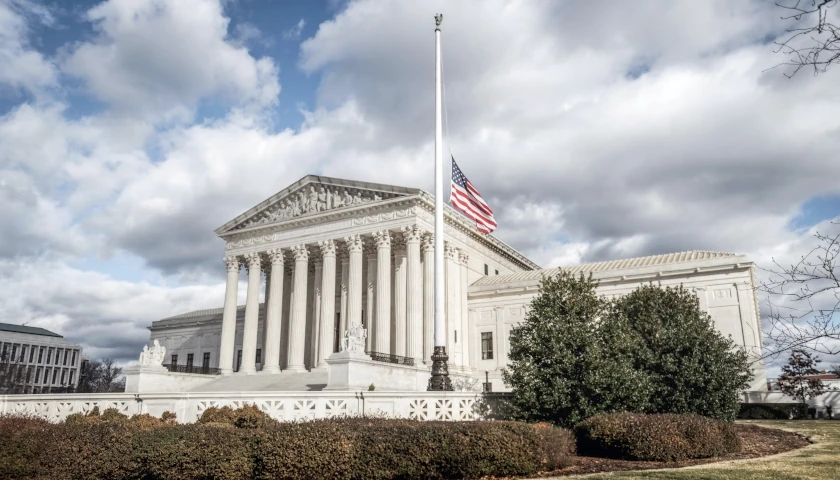
In a pair of high-stakes U.S. Supreme Court cases testing the meaning of key federal statutes, legal commentator and retired attorney Mark Pulliam argued the outcomes may hinge on what he views as straightforward textual interpretation.
The two cases before the Court – Noem v. Al Otro Lado and Watson v. Republican National Committee – focus on distinct but similarly technical questions of statutory meaning.
Noem v. Al Otro Lado asks whether asylum seekers stopped on the Mexican side of the border can be considered to have “arrived in the United States” under federal law while Watson v. Republican National Committee examines whether federal statutes establishing a uniform Election Day override state laws that allow mail-in ballots to be counted after Election Day, so long as they were sent by that date.
Speaking Monday on The Michael Patrick Leahy Show, Pulliam pointed to Noem v. Al Otro Lado as “a perfect case for a textualist analysis.”
“So you have to look at it and say, does ‘arrive in’ mean in a logical reading of the words still in Mexico,” he said.
The case challenges a Trump-era policy requiring asylum seekers to remain outside the U.S. while their claims are processed. Pulliam contrasted that approach with earlier enforcement practices.
“In the old days, they would let you in, you would claim asylum, and then they would give you a court date and you would disappear into the heartland,” he said. “And this was called the catch and release.”
He argued that ambiguity in immigration law has contributed to inconsistent enforcement.
“The immigration laws, unfortunately, are very—they’re like the tax code,” Pulliam said. “They’re voluminous and a lot of ambiguous terms, confusing terms, and they have never been enforced in a rigorous manner.”
Pulliam connected that same concern about statutory clarity to Watson v. Republican National Committee, which addresses whether ballots must be received by Election Day or simply postmarked by then.
“So now we have, and we’ve had for a very long time this sort of uniform official Election Day,” he said. “The question is that increasingly people are allowed to…vote by mail-in ballot rather than by showing up in person.”
He noted that while states require ballots to be sent by Election Day, some accept them after Election Day.
“All the states agree that the mail-in ballot has to be postmarked at least by election day,” Pulliam said, “but 14 states, including the District of Columbia, allow ballots that are not received by Election Day to be counted sometimes for weeks after Election Day.”
“In the 2024 election, more than 750,000 ballots were counted after Election Day,” he added.
Based on oral arguments, Pulliam suggested the Supreme Court may favor narrower readings of federal law in both cases. He described a “predictable split” among the justices and pointed to tough questioning from Justices Sonia Sotomayor and Ketanji Brown Jackson, while noting the relative silence of Elena Kagan.
“You do not see any comments being attributed to Elena Kagan,” he said. “It may be that she’s smart enough to realize that this is not a winning argument.”
Pulliam suggested the Court could deliver a decisive ruling. “It might be [7–2],” he said.
Decisions in both cases are expected by late June.
Tune in now to The Michael Patrick Leahy Show – your AMERICA FIRST news talk!
– Watch LIVE here on X
– Watch LIVE on YouTube / Rumble / Roku / AppleTV
– Listen on Spotify
– Listen on WENO AM760 in Nashville
– Read more at @TheTNStarhttps://t.co/mMThZ2LmIT— Michael Patrick Leahy (@michaelpleahy) March 30, 2026
– – –
Kaitlin Housler is a reporter at The Tennessee Star and The Star News Network. Follow Kaitlin on X / Twitter.